On the night of April 30, a Russian soldier attacked a large family in the village of Giry, Kursk region, liberated from the Ukrainian Armed Forces: he shot Olesya Larina, wounded her husband Igor, and captured their daughters aged six and ten. Eyewitnesses say that he was “inadequate”. ASTRA and Mediazona found out the suspect’s biography, talked to a friend of the Larin family who saw the killer in their house, and asked his fellow villagers about life and mood in the border region, where there are now fewer civilians than military personnel, many of whom have recently left the colonies.
Fellow countrymen
The first of May in the border Belovsky district of the Kursk region turned out to be alarming: in the evening, in the local chat “Fellow Countrymen “(“Astra “and” Mediazona ” have screenshots of all the quoted messages from the chat), the news of the Mash channel that either 60 or 200 AFU fighters were wandering nearby were discussed. Supposedly they fell behind during the retreat and now they can’t go back to Ukraine.
One woman incorrectly retold the news, and people assumed that the Ukrainian army had invaded the area again.
— How did they get this far?”
— Be more clear!
— People already thought that a breakthrough in our area.
— After such statements, half the district won’t sleep.
— For God’s sake, would they have told me how it is, should I leave or should I go to bed? Hundreds of versions and assumptions.
Two days earlier, in the village of Giri, a Russian soldier entered the home of the Larins’ large family, shot 41-year-old Olesya and wounded her husband Igor. Then he tried to take the girls, aged ten and six, away, but was stopped by security guards at a nearby military medics’ dorm.
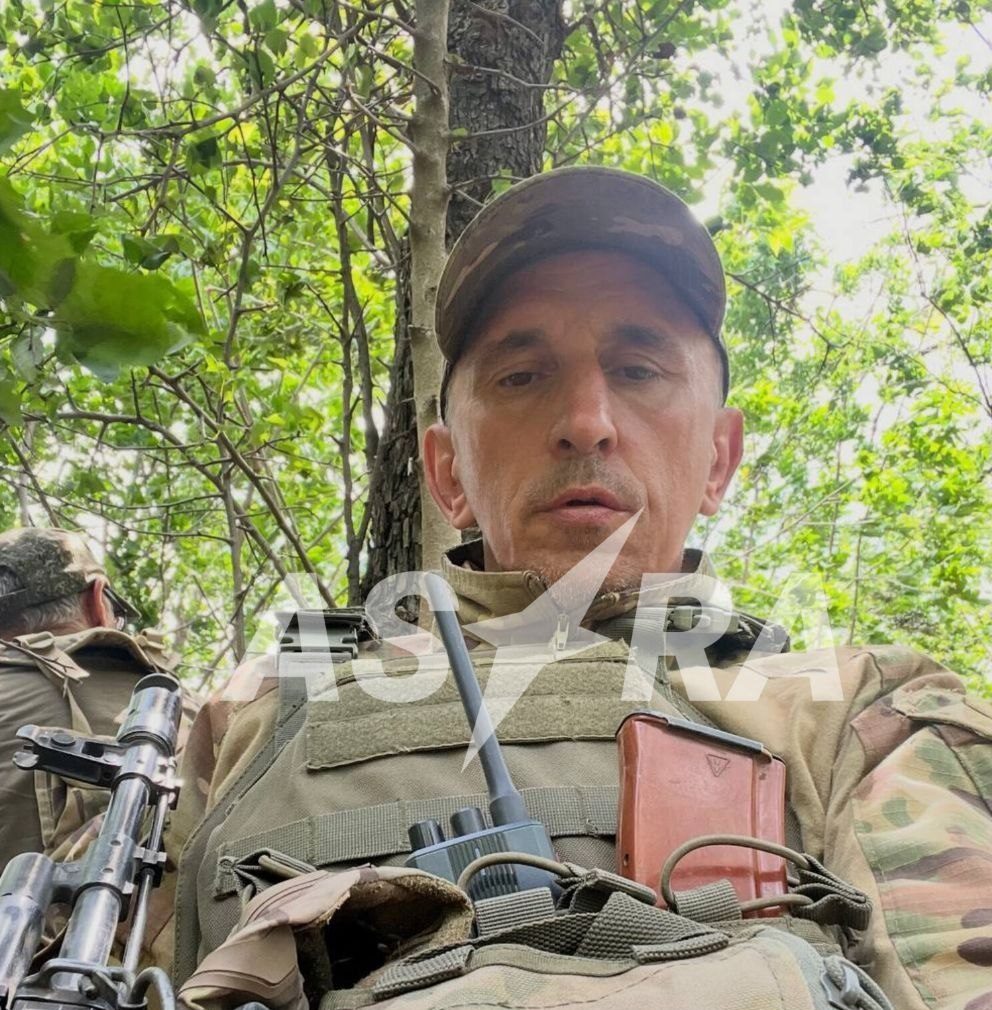
The military man was detained, but no official agency has commented on the incident. On the evening of May 1, Ilya Larin, the eldest son of Olesya and Igor, posted a photo of the suspect in the district chat. Curses poured down in the comments.

Photo courtesy of Ilya Larin
— An animal.
— Really ugly. The face is disgusting.
— he was hit, Ilya explained in response.
— Not enough!!!
— Not enough.
The deceased woman, as neighbors told Radio Svoboda, used to work as a milkmaid on a collective farm, but then most of the villagers left the village, and the farm was closed. Olesya became unemployed.
The Neighbors chat consists of almost five and a half thousand people. In their posts — fears that the authorities will try to hush up the crime of a military man, combined with dissatisfaction with the fact that the details of the murder are being sniffed by correspondents of unclear publications.
However, some people in the chat believe that publicity will not hurt, and agree to talk to journalists, mostly anonymously.
When units of the Armed Forces of Ukraine invaded the Kursk region in August 2024, many border settlements were deserted. Giry are no exception. Kursk Governor Khinshtein referred the village as a “gray zone” and adviced residents who had left from returning. The media wrote less about the Belovsky district than about the neighboring Sudzha, but Ukrainians came here too. Four captured soldiers of the Armed Forces of Ukraine were later convicted under the article on the terrorist attack for 17 and 16 years of strict regime. As stated in the verdict, “in order to block and keep the settlement under armed control, the militants equipped observation and firing positions in the surrounding area with a unified system of reconnaissance, fire and communication.”
Nikolai (name changed), who did not leave the village, says that the Ukrainian soldiers behaved “seemingly normally.” However, the village did not remain under the control of the Ukrainian Armed Forces for long, and the Russian military came to Giry.
At first, as local residents recall, they were fighters of “Akhmat” — a curious case, presumably looting, is connected with their appearance, which was caught on video: a bearded man in camouflage and slippers takes a cackling goose on a bicycle to the laughter of the cameraman.
“This is at first, in August [2024], well, these are non-Russians,”Akhmat”, Chechens, not ours. We have our own Russians here [now],” explains Nikolai.
Otherwise, he says, the residents who remained in Giry had no problems with the Russian military: they brought humanitarian aid, sometimes asked to use their showers. Alexey adds that the military even looks after the abandoned property of families who have moved to safer places — this is what Alexey himself did, now he lives in Kursk. His house in Giry came under fire, and the man complains that the authorities are in no hurry to issue him a certificate for the purchase of new housing.
“Before the invasion [of the Armed Forces of Ukraine in the Kursk region], there were not so many military men in Weights. When SMO first started, they lived in recreation centers, dormitories, and forests. Now it is on my street that people live in abandoned houses. There are those who rent houses from civilians for money, ” says Sergey.
According to him, at best half of the inhabitants remained in the village — about 200 people: “Accordingly, there are now more military personnel than civilians.”
“I want to say that the ambulance is not coming here. We had an accident, my father helped us, called an ambulance, but said they wouldn’t go, as a result, the military took the man to the district hospital,” he recalls.
Although local residents avoid criticizing the Russian military when they talk to journalists, they complain in the district chat that they are reckless on the roads, buy vodka in circumvention of the “dry law” and molest women.
“The military went after the girls and said behind their backs:” Do you want the right or the left one?”. In the store they said: “Look, what girls, should we put them in the trunk and in the forest?” And how did you drive up and offer to get acquainted? And this is all-just cases in Giry,” writes one of the chat participants.
“Although alcohol cannot be sold here by law because of the KTO (anti terrorist) regime, everything is sold here, in Belaya and Peschana. Well, of course, there are people who make moonshine, ” says Sergey. In the district chat, they write that a bottle of vodka can be bought for 1,200 rubles, although, says Sergey, in small shops of the Kursk border region, prices change daily.
Contract soldier Andrey (name changed), who was sent to the Kursk region in December 2024, admits that the military’s relations with the civilian population are not ideal.
“Everyone treats the military very differently. “Akhmat” shifted the attitude with its looting, but at first there was no infantry in large numbers — it was on the Sudzha and other directions, and now it is onlly infantry that went there: the 155th brigade, the 30th regiment of the 72nd motorized rifle division, where former prisoners, and new contractors, low-level soldiers qualities were. They’re all kind of battered, they smell like alcohol, I don’t know where they get it from,” says Andrey.
Former prisoners and Wagner soldiers, he says, began to be transferred to the Belovsky district at the end of March, when the AFU tried to break into the neighboring Belgorod region — that is, a month and a half before the murder of Olesya Larina.
According to him, in Giry they are unhappy that Russian gunners have set up a firing position nearby, that the military walk around the village in uniform and leave their cars near houses — all this can put civilians at risk.
However, a friend of the Larins ‘family, Alexander Zuev, says that in the Giry themselves “guns are not particularly visible”, the military move mainly at night, and “drive hard” so as not to come under fire. He has no complaints about the army: “They are fighting here, and we are slightly interfering with them.”

“In short, someone killed my mother”
On the night of April 30, a soldier tried to enter the house of Olga and Igor Larin under the pretext of checking documents, their 18-year-old son Ilya, who lives in Kursk, told Astra and Mediazona. According to him, the soldier’s name is Dmitry Stenkin; the same name and surname are given by the telegram channel “Pepel”.
“We don’t have such document checks at midnight. Sometimes a rapid response team can come by during the day to check the documents, but this has not happened since the Ukrainians attacked,” explains Alexander Zuev, a friend of the Larins’ family.
“Somewhere at fifteen minutes to one, Ilya called me. I ask him what happened? He cries, ” Please go to my house. My younger sisters called me, in short, someone killed my mother.” ” I got in the car and drove to their house. Then I thought, you know, maybe the girls made it up, maybe their parents are just fighting,” Zuev recalls. He didn’t turn off the engine, thinking that everything would be clear in a couple of minutes.
However, the windows in the house were broken, and the door was broken. The first thing Zuev saw inside was a pool of blood and bloody footprints, “clearly not children’s.” He remembered that shell casings 5.45 were scattered around the house.
“I went to the room, there was a lot of blood, just insanely amount of blood. From the hall I saw the bedroom, where Oleska was dead. She was in a semi-sitting state, leaning against the bed with her head bowed. I repeated it several times: “Girls, where are you?” They said, “Uncle, uncle, quiet, quiet,” Alexander recalls.

The killer was still in the house — according to Zuev, in the same room as the body of the murdered Olesya. Then he looked around the corner and opened fire in the direction of Alexander, “not in a queue, but in single shots, but quickly.” Zuev at that moment was standing “in the crotch of another door, leaning on it, calling the girls.”
“It’s good that their door is slightly sideways, if it was straight, probably [you] wouldn’t have anyone to talk to by now,” he adds.
After the shots were fired, Zuev ran out into the street and met the neighbors — they had already called the police, but still continued calling the station. Near the entrance of a neighboring high-rise building, he saw Igor Larin.
“When I met Igor, he was in his right mind. He was shot through the arm, shoulder and chin. He even talked and asked about the children. Until the last moment, he was in good health. Now they put him in an artificial coma and moved him to Moscow, as I know, so that he would not suffer from pain shock, ” says Alexander.
While they were standing on the street with neighbors, the killer left the Larins ‘ house and got into Zuev’s car parked nearby. He took both girls with him: “He probably wanted to kidnap the children, but I do not know why he did it at all. He drove literally 400 meters. There is already a college, where military medics were settled, and a protected area. He was immediately stopped.”
Zuev says that by the time of his arrest, the criminal had shot all his bullets.
About 40 minutes after the first call, the military police arrived at the scene, Alexander continues. He saw the shooter after the arrest — he “was completely inadequate, told different stories all the time, denied everything and said that he himself came to the sound of gunshots.”
Dima Bandit, his brother and their mother
39-year-old Dmitry Stenkin from Astrakhan went to the army instead of another term in a penal colony.
In his penultimate sentence in the fall of 2024, it was noted that the man was diagnosed with “alcohol dependence syndrome” and “organic personality disorder”, but he has a cohabitant with a young child in his care. It also listed Stenkin’s previous convictions.
In 2017, he received 4.5 years for rape. He was released in 2021.
A year later, he was sentenced to correctional labor for evading administrative supervision, and in 2022, he was given another 10 months of strict regime for threatening to kill.
In October 2024, the court sentenced Stenkin to 2 years of strict regime on charges of assaulting a police officer: as stated in the verdict, he drank “at night outside the residential premises”, violating the conditions of administrative supervision, and hit the inspector with his elbow and head, when he took him for examination to the drug dispensary.
After that, in January 2025, Stenkin was added another five months for another episode of evading supervision.
Probably after that he signed a contract with the Ministry of Defense and went to war. Ilya Larin and Alexander Zuev call the 810th separate Marine Guards Brigade his place of service, but ASTRA and Mediazona could not confirm this information. Verstka wrote that the 810th brigade suffered “hellish” losses in the Kursk region.
Probably, “Dima Bandit” (the so-called telegram account registered to Stenkin’s number) began his criminal career in the early 2010s. In Odnoklassniki social network there is a profile “Dima Stenkin”, the owner of which indicated the same date of birth as Stenkin from Astrakhan. In 2013, a photo of a young man wearing a black prison uniform appeared there. Documents about Stenkin’s criminal record before 2017 could not be found in the public domain.

Judging by the leaked databases, Dmitry Stenkin has an older brother, Yuri — they have the same registration addresses in Astrakhan and same patronymics.
In 2011, Yuri Stenkin was sentenced to 7 years in a high-security penal colony for accidentally killing his own mother. In the verdict, Yuri’s testimony is given: he and his mother were drinking, she began to insult his common-law wife and child, threw a frying pan at her son, he pushed her in the shoulder, the mother hit the nightstand and ran out of the apartment. A few hours later, a neighbor found a woman lying in her underwear at the entrance. Together with Yuri, they brought her to her senses and brought her to the apartment. The defendant said that he went to a neighbor’s house to call an ambulance, and when he returned, he found his mother already dead — he insisted that he did not kill her.
“Looking for hooker girls”
Olesya Larina was buried on May 2. At the time of publication, her husband is still in an induced coma. The girls’ older sister came from Moscow, and now they all live together with Ilya Larin in Kursk.
Neighbors told Ilya that on the day of the murder, Stenkin allegedly walked around the village and “looked for hooker girls.”
Ilya does not know why the soldier decided to break into the Larins ‘ house, but according to the same neighbors, before the attack, he had followed Olesya when she was walking with her daughters.
“At night, my father opened the door for him, [Stenkin] began to boast his rights to his mother, and my father began to resist,” says Ilya. “If I’d been home that day, I would have killed the bastard.”
After the incident, the Investigative Committee spoke with Ilya and his younger sisters. He doesn’t know what Stenkin’s current legal status is, but he worries that the military police are “most likely trying to cover up” the murder.
On May 2, the Kursk Garrison Military Court sent Dmitry Stenkin into custody, the press service confirmed to ASTRA and Mediazone. At the same time, the court refused to name the article under which the suspect was arrested. In the official channels of law enforcement agencies and censored media about the murder of a large mother in the Kursk region has not yet written a word.
Sergey from Giry is outraged by this. “I believe that the authorities should say and warn that this is possible, so that people do not open the door to strangers to the military, and in principle to anyone. And to punish those who sell alcohol, ” he says.
Although the unofficial chat of the Belovsky district continues to raise money for equipment and drones for the army, the confidence of local residents in the military is undermined.
“People have returned to the Belovsky district mainly in order not to lose their jobs — we have factories working, the feed mill is working, the asphalt plant is working. Many of them have farms, but many of them have already had their own private farms stolen during their absence. The situation with the military, of course, is also twofold,” says Sergey. — When they were not here, the result was that the AFU entered the village. It seems safer that way (with Russians), but after yesterday’s incident, you don’t know what to be afraid of anymore. They come to our village so often anymore, so it’s more scary to be killed by our owns than by enemy drones.
Authors of the material: Dmitry Shvets, Andrey Kaganskikh, Anastasia Chumakova, Dmitry Tkachev.